
Becoming a Painter and Decorator in Malta: Setup, Quoting and Finding Work
Painting is one of the easier trades to start on your own, and one of the easiest to underprice. This guide helps you pick your kind of work, register properly, quote with care and keep the diary full.
Updated 2 November 2026 · 6 min read

Pick the kind of painting you want to do
"Painter" covers very different jobs in Malta. Strong sun, salt air near the coast and winter rain on old limestone all shape the work. Decide where you want to focus, because it changes your tools, your insurance questions and your clients.
| Type of work | Typical clients | What you need to be good at |
|---|---|---|
| Interior walls and ceilings | Homeowners, tenants moving out, landlords | Clean edges, protecting floors and furniture, fast turnaround |
| Façades and outside walls | Owners of houses and blocks of flats | Working at height, weather planning, paints that stand up to sun and salt |
| Damp walls and roofs | Owners of older houses and top-floor flats | Finding the cause of damp, waterproof coatings |
| Decorative finishes | Homeowners, shops, restaurants | Textured coats, feature walls, colour matching |
| Rentals and short lets | Landlords, agents, property managers | Quick repaints between tenants, reliability, clear invoicing |
| Fit-out and new builds | Contractors and finishing firms | Working to a programme alongside other trades |
You can do a mix. Still, a clear specialism, such as façades or damp, is easier to explain to a client and easier to price.
Registering as a self-employed painter
Before you take money for a job, put your status in order. Business 1st can help with the formalities if you prefer to go in person rather than online.
Business 1st says sole traders need to register with Jobsplus as self-employed, and can start trading straight away as long as the required permits and registrations are carried out. It also notes that a sole trader is taxed on profits even if the owner does not draw them.
SourceWhen registering online with Jobsplus, the designation you enter should match your role, and Jobsplus asks you not to enter "owner" or "director". If you run more than one self-employment, for example painting and a separate activity, each occupation needs its own form.
SourceUnder the Social Security Act (Cap. 318), a self-occupied person is a self-employed person earning more than nine hundred and ten euro a year from an activity (the figure at the time of writing, November 2026), and pays Class Two contributions. Payments are made in arrears at four-month intervals ending on the last day of April, August and December.
SourceVAT: which registration suits a painter?
Paint, primers, rollers, sprayers and scaffolding hire all carry VAT. Whether you can claim that back depends on how you register, so look at who your clients will be.
| Question | Article 10 | Article 11 (small enterprise) |
|---|---|---|
| Do you add VAT to your invoices? | Yes, on taxable work | No, the supplies are exempt without credit |
| Can you claim back VAT on paint and equipment? | Yes, as input tax | No |
| Is there a turnover limit? | No | Yes, the domestic threshold |
| Who it tends to suit | Painters working for VAT-registered businesses and contractors | Painters working mainly for households |
Under the VAT Act (Cap. 406), at the time of writing (November 2026) the domestic threshold for the article 11 small enterprise scheme is thirty-five thousand euro of turnover in Malta in a calendar year. A person who must register under article 10 applies within thirty days of making a supply for consideration in Malta.
SourceThe right choice depends on how much paint you buy, who your clients are and how fast you expect to grow. An hour with an accountant before you register is cheaper than switching later.
Quoting a painting job properly
The paint is rarely the biggest cost. Time is. Preparation, drying between coats and moving around furniture eat into a day, and they are easy to forget when you price. Always see the job before you give a figure.
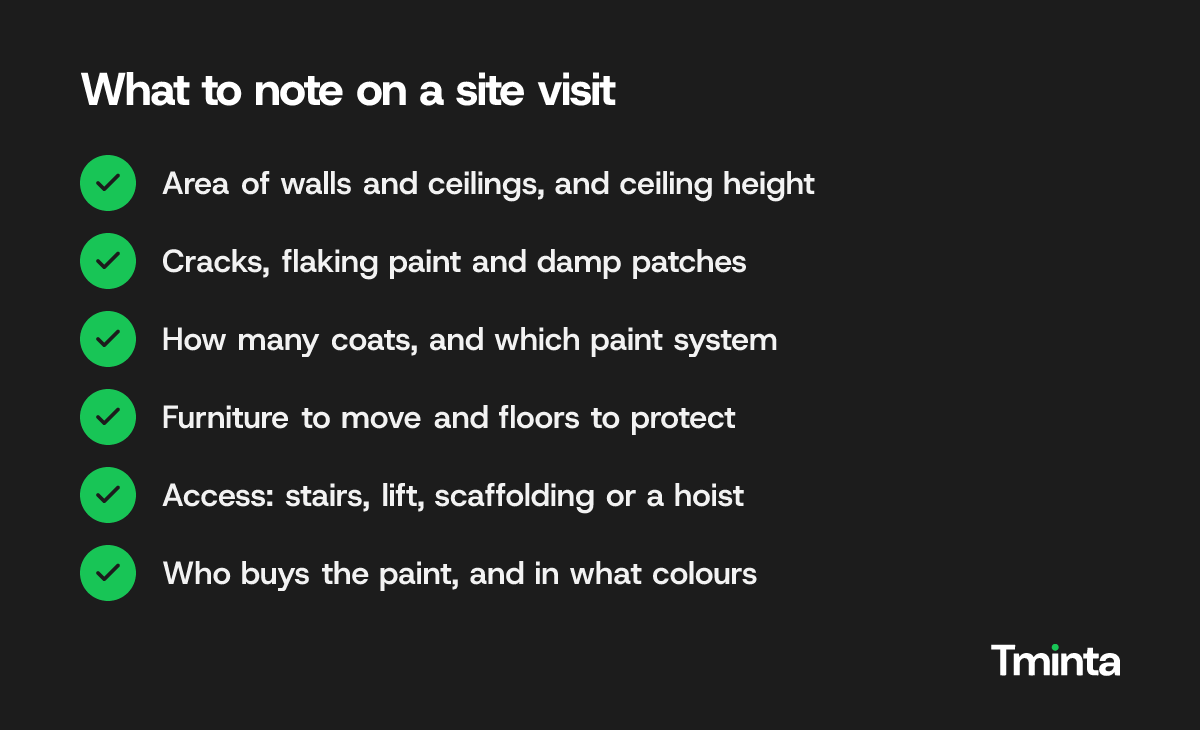
- Price preparation as its own line, so the client sees why a cheaper quote may skip it.
- Name the paint brand and type, the number of coats and the colours in the quote.
- For outside work, allow for weather. Rain and strong wind stop façade work, and hot sun can make paint dry too fast.
- Say what happens if you find a bigger problem, such as damp behind old plaster.
Rules and good habits on site
The Construction Management Site Regulations (S.L. 623.08) set the permissible hours for works that generate noise heard from outside the site: they may not start before 7am and must stop by 8pm, and no construction works may be carried out on Sundays or public holidays.
SourcePainting itself is quiet, but sanding, scraping and pressure washing are not. Keep those inside the hours, and tell neighbours in a block of flats before you start on a common stairwell or façade.
When damp is the reason the client called you, find the cause before you paint. A leaking roof, a broken drainpipe or rising moisture in old stone will push through any coating. Refer the roof or the pipe to the right trade, and paint once it is fixed. Clients remember the painter who told them the truth.
Finding steady painting work
Painting has seasons. Outside work bunches up in the dry months, and interiors fill the rest of the year. Build a mix of clients so a wet week does not empty your diary.
- Landlords and letting agents need flats repainted between tenants, often at short notice.
- Finishing contractors and builders subcontract painting at the end of a project.
- Owners of older houses need damp treatment and repainting every few seasons.
- Shops and restaurants want work done outside opening hours, which suits a small crew.
After each job, take photos in daylight and ask for a short review. A gallery of crisp edges and even colour on real Maltese homes persuades the next client. Tilers and plasterers you meet on site can also pass work your way: see our guide for the self-employed tile layer.
Be easy to contact
Clients looking for a painter want to see your work, your area and how to reach you. A profile that shows those three things answers their first questions before they call. Listing on Tminta is free: list your business and clients can call or WhatsApp you direct.
Want to see what clients compare? Browse home improvement services to see how other trades present themselves.
Questions people ask
Is it hard to become a painter in Malta?
Learning to paint well takes practice, especially preparation, cutting in and façade work. Setting up is simpler: register your self-employment with Jobsplus, sort out VAT and pay Class Two contributions. The real challenge is pricing jobs so you are paid for preparation and drying time, and building enough regular clients to keep busy all year.
Do painters need a licence in Malta?
You must register as self-employed with Jobsplus and have a VAT number. The site regulations still apply on renovation and building sites, including the permissible hours. If a job grows into building or demolition work, that needs a BCA licensed contractor. Ask the BCA if you are unsure whether a specific job is covered.
How much does a painter charge per day in Malta?
Painters set day rates or job prices based on their costs and the work: preparation, the number of coats, the paint, ceiling heights, access and travel. Work out what your van, tools, insurance, contributions and time off cost you, then add a margin. Quoting per job after a site visit protects you better than a flat day rate.
What can a painter earn in Malta?
As a self-employed painter your income is what is left after your costs, so it depends on how you price, how many days you fill and the type of work you take on. Specialist work such as façades, damp treatment and decorative finishes usually needs more skill and equipment, which you can reflect in your quotes.