
10 Things to Check Before You Hire a Web Designer in Malta
A website is quick to start and slow to untangle if it goes wrong. These ten checks cover the brief, ownership, the Malta rules your site has to follow, the quote and the care it needs after launch.
Updated 2 November 2026 · 5 min read

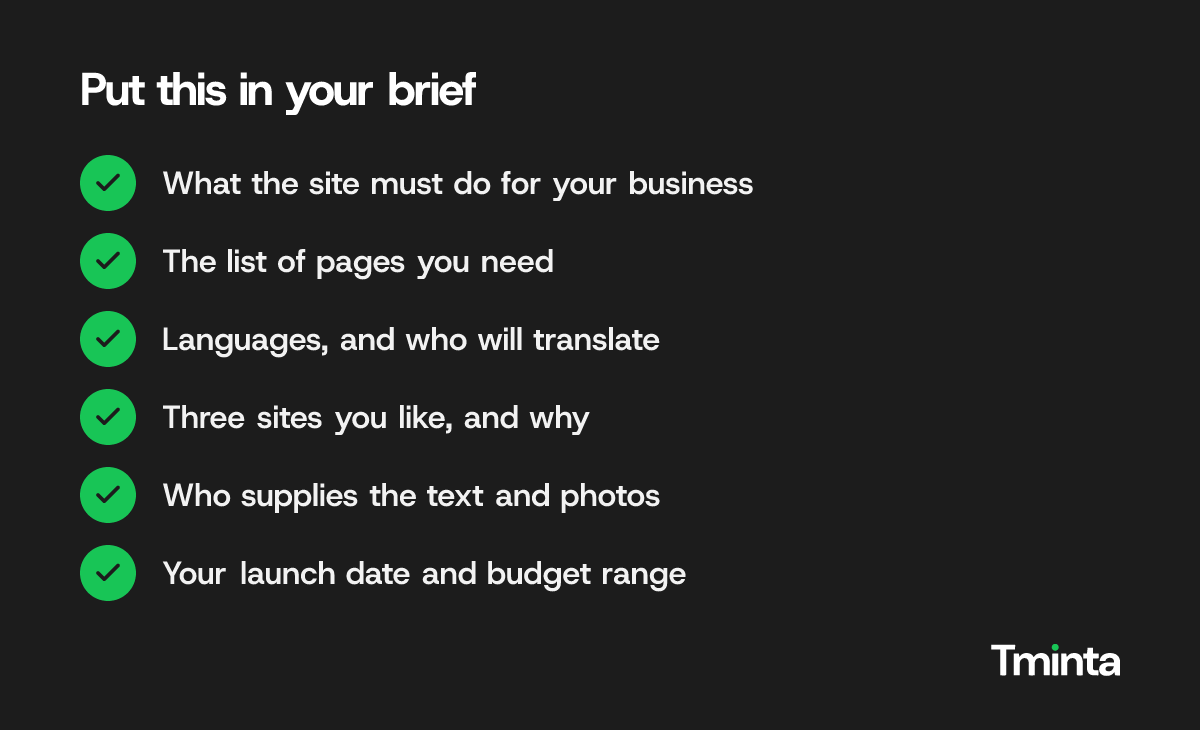
1 to 3: Decide what the site is for
Start with the job the site has to do. A café needs opening hours, a menu and a tap-to-call button. A guesthouse in Gozo needs photos, a map and a booking link. A shop needs products, payments and delivery options. Designers quote very differently for each, so say it plainly at the start.
Next, list the pages and the languages. English alone, or English and Maltese? Italian or German for tourists? Every extra language is more text to write, check and keep up to date.
Third, decide who supplies the content. Sites stall for weeks while the owner looks for photos or writes the About page. If you need help, a content writer and a photographer can work alongside the designer.
4 and 5: Who owns the domain, the hosting and the design
This is the check people skip, and the one that hurts most later. If the designer registers the domain in their own name and then stops answering, moving your site can be slow and painful. Ask for every account to be set up in your name, with your email address, and for the designer to be added as a user.
| Part of the site | Should be in | Why it matters |
|---|---|---|
| Domain name (.mt or .com) | Your name or your company | Whoever holds it controls your address and your email. |
| Hosting account | Your name, designer added as a user | You can move host without asking permission. |
| Website admin login | Your own admin account | You can edit pages or bring in someone new. |
| Design files, theme and code | Transferred to you in writing | Copyright starts with the person who made it. |
| Analytics and Google Business Profile | Your Google account | Years of data stay with your business. |
| Business email | Your name | Losing email access is worse than losing the site. |
Under the Copyright Act (Cap. 415), copyright vests first in the author. An assignment or licence of copyright has no effect unless it is made by an agreement in writing between the parties.
SourceWhen the site goes live, ask for every login in one document: domain, hosting, admin, email, analytics. Store it somewhere safe that does not depend on the designer.
6 and 7: The rules your site has to follow
A designer is not your lawyer, but they build the parts the law cares about: the cookie banner, the contact page and the checkout. Ask how they handle each one.
Under the Processing of Personal Data (Electronic Communications Sector) Regulations (S.L. 586.01), storing or reading information on a visitor's device, such as cookies, is only allowed with the visitor's consent, after clear and comprehensive information. Storage strictly needed to provide a service the visitor asked for is exempt.
SourceMalta's Information and Data Protection Commissioner says valid consent must be freely given, specific, informed and unambiguous, and gives a website banner with pre-ticked boxes as an example of consent that is not valid.
SourceIn practice, ask the designer whether analytics, ad pixels and embedded videos load before the visitor says yes. A banner that only says "we use cookies" with an OK button may not be enough.
Article 8C of the Electronic Commerce Act (Cap. 426) says a service provider must make certain details easily, directly and permanently accessible, including its name, its geographic address, contact details with an email address, and its VAT identification number where the activity is subject to VAT.
Source8: Compare quotes on the same terms
Two quotes for "a website" can describe very different jobs. Send each designer the same brief and ask them to price these points one by one.
| Factor | Ask the designer |
|---|---|
| Pages and templates | How many page layouts are included, and what does an extra one cost? |
| Online shop | How many products will you load? Which payment provider and delivery options? |
| Custom design or theme | Is it a ready-made theme, adapted, or designed from scratch? |
| Content | Do you write, translate or edit text, or do I send it ready? |
| Rounds of changes | How many rounds are included before extra time is charged? |
| Hosting and domain | Are they in the quote, and who pays the yearly renewals? |
| Training | Will you show me how to edit pages and add products? |
Under the VAT Act (Cap. 406), a tax invoice must show the supplier's VAT identification number, the VAT rate applied and the VAT amount. Supplies by a small enterprise registered under article 11 are exempt, so a designer registered that way does not add VAT.
SourceSo ask whether the price includes VAT before you compare. If you run a VAT-registered business, you will want a proper tax invoice to claim it back.
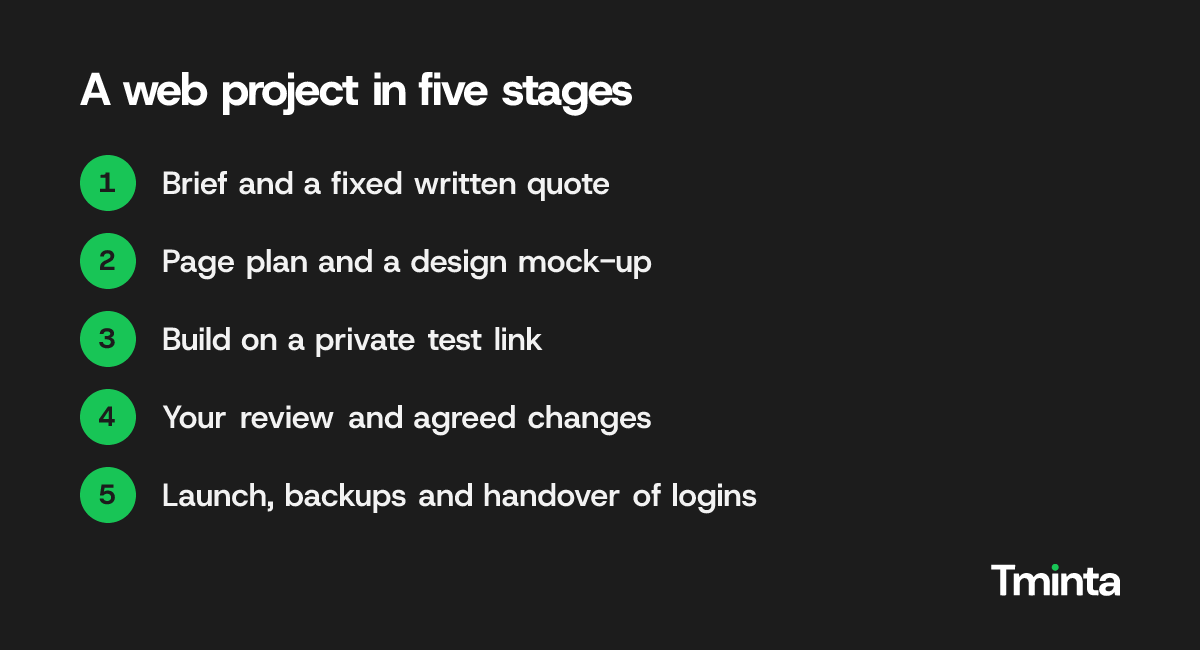
9: Agree the stages and how you sign off
A clear process protects both sides. Link each payment to a stage you can see, and agree in writing what counts as "finished".
10: Plan for life after launch
Most sites need regular care. Plugins and themes need updates, backups need testing, and forms stop working when nobody checks them. Ask these questions before you sign:
- Is maintenance a monthly plan, or paid per job?
- How fast do you reply if the site goes down?
- Where are backups kept, and how often are they made?
- If I stop the plan, can I move the site to someone else?
- Who renews the domain and the security certificate?
Need booking rules or links to other systems? A web developer may suit you better. No logo yet? Start with a brand designer, so the site has something to build on.
Questions people ask
How much does a website cost in Malta?
It depends on the number of pages, whether you need an online shop, how many languages, whether the design is custom or based on a theme, and who supplies the text and photos. Hosting, the domain and maintenance are often priced separately. Send the same brief to two or three designers and ask each one to list what the price includes, and whether VAT is added.
Who should own my website domain?
You should. Register the domain in your own name or your company's name, with an email address you control, and give the designer access as a user. The same goes for hosting and the website admin account. If the designer holds them, ask for a written handover before the final payment.
Does my website in Malta need a cookie banner?
If the site stores or reads cookies that are not strictly needed for a service the visitor asked for, such as analytics or ad pixels, Malta's rules require the visitor's consent first. Ask your designer how the banner works, whether tracking waits for a yes, and whether refusing is as easy as accepting.
Should a web designer in Malta charge VAT?
It depends on how they are registered. A designer registered under article 11 of the VAT Act as a small enterprise does not add VAT, while others do. Ask before you compare quotes, and if you run a VAT-registered business, ask for a tax invoice that shows their VAT number, the rate and the amount.