
Setting Up as a Handyman in Malta: Registration, Limits and First Customers
Starting as a handyman in Malta takes more than a drill and a van. Here is the registration you need before the first paid job, the jobs you should leave to licensed trades, and practical ways to build a steady list of customers.
Updated 2 November 2026 · 6 min read

Decide what you will and will not take on
A handyman sells range: the shelf, the dripping tap, the wardrobe that arrived in forty pieces, the door that sticks every August. That range is the whole appeal, but some tasks in Maltese homes are regulated, and the job title does not change that. Draw your line before a customer asks you to cross it.
| Request | Fine for a handyman? | What to check first |
|---|---|---|
| Assemble flat-pack furniture, hang shelves, mirrors and curtain rails | Yes | What the wall is made of, and where pipes and cables run. |
| Reseal a bath, change a tap washer, unblock a sink | Yes | Where the stopcock is before you open anything. |
| Touch up paint, fill cracks, fix a sticking door or shutter | Yes | Whether damp is behind the crack. Paint will not fix it. |
| Add a socket, a new light point or a circuit | Only with a REWS authorisation | Refer it to an authorised electrician if you hold none. |
| Open a doorway or take out a wall | No, unless you hold a construction licence | These count as minor works under the contractor licensing rules. |
Under the Electrical Installations Regulations (S.L. 545.24), installing, altering, extending or certifying an electrical installation needs an authorisation issued by the Regulator for Energy and Water Services (REWS).
SourceThe Construction Industry Licensing Regulations (L.N. 166 of 2023) define "minor works" to include opening or closing apertures and removing or building walls, and say minor works can be carried out by the holder of a construction licence issued through the Building and Construction Authority.
SourceSaying no to a job is not lost business. Pass it to an electrician or builder you trust and ask them to send small jobs your way in return. Referrals between trades are one of the cheapest ways to fill a diary.
Register before your first paid job
Helping a neighbour for a coffee is one thing. Once people pay you, you are running a business, and the state expects to know about it. The order below keeps things simple.
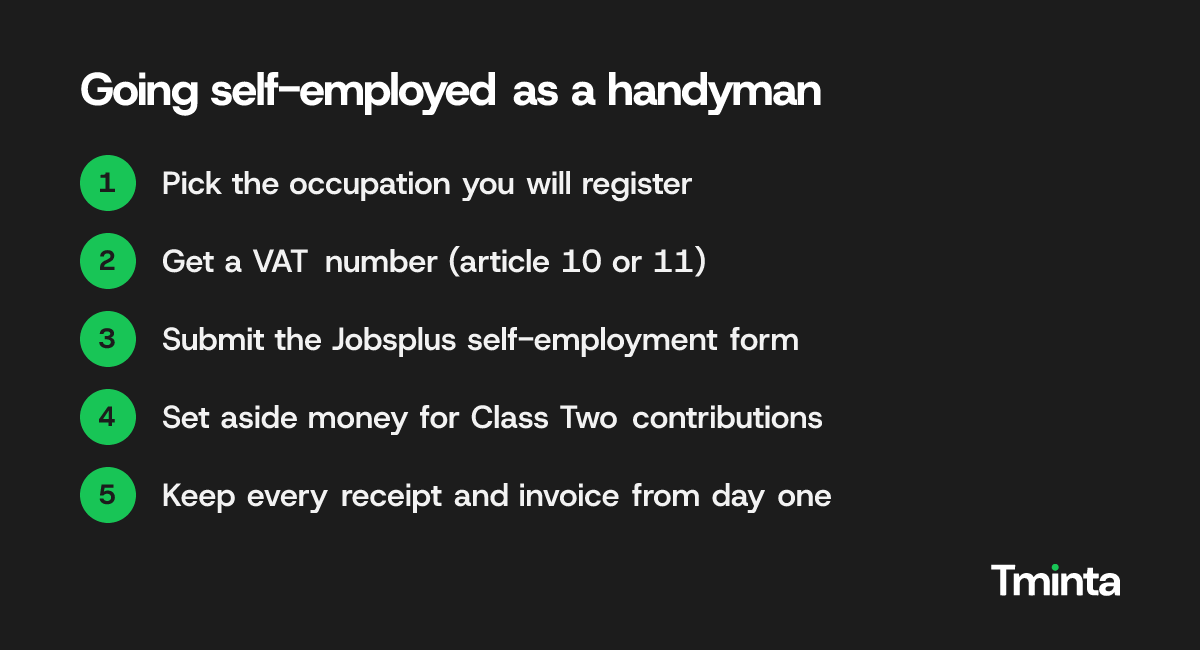

Jobsplus lets you register self-employment online from the "Self-Employment" tab on your Jobsplus dashboard, or by emailing the downloaded form. Jobsplus lists a VAT number as a requirement, and a PE number once you recruit your first employee. If you have more than one self-employment, you submit a separate form for each occupation.
SourceBusiness 1st states that sole traders need to register with Jobsplus as self-employed, and that Maltese sole traders do not need a separate registration with the Malta Tax and Customs Administration, because the tax registration number is the same as the ID card number.
SourceUnder the Social Security Act (Cap. 318), a self-employed or self-occupied person pays Class Two contributions. At the time of writing (November 2026), "self-occupied" means earning more than nine hundred and ten euro a year from an activity, and contributions are paid in arrears for four-month periods ending on the last day of April, August and December.
SourceNot Maltese? Sort out the extra steps before you print business cards.
Business 1st says EU citizens who are yet to start self-employment must first apply for a Maltese social security number, and that third country nationals need an employment licence, which is only granted in exceptional cases.
SourceVAT: the small enterprise route or full registration
Most new handymen work for households, who cannot reclaim VAT. That is why many start under the small enterprise scheme. If you will mostly work for companies, landlords with a VAT number or contractors, full registration may suit you better. Ask an accountant to run both options on your own figures.
Under the VAT Act (Cap. 406), a taxable person established in Malta applies to register under article 10 within thirty days of making a supply for consideration. A person who qualifies as a small enterprise may instead apply under article 11. At the time of writing (November 2026), the domestic threshold for a small enterprise is thirty-five thousand euro of turnover in a calendar year. Supplies under article 11 are exempt without credit, so you do not charge VAT and cannot claim back the VAT on your tools and materials.
SourceFor more on records, expenses and returns, see our freelancer's guide to tax, sales and expenses.
Tools, transport and how to charge
You do not need every tool on day one. Buy good versions of what you use weekly (drill, detector for pipes and cables, spirit level, sealant gun, ladder) and hire the rest. A small van or a car with a roof rack matters more than a big one: parking in Valletta, Sliema or the narrow cores of the villages decides how many visits you fit into a day.
- A call-out charge covers your travel and the first part of the visit. Say it up front, and say whether Gozo costs more.
- An hourly rate suits small mixed jobs. A fixed price suits jobs you can see clearly, like assembling a wardrobe.
- Materials: decide whether you buy them and add them to the bill, or the customer buys them. Put it in writing.
- Batch jobs by area. Three visits in one town beat three visits across the island.
A two-line message with the price, what it includes and the day you will come is enough for most small jobs. It saves arguments later and looks professional.
Finding your first regular customers
Handyman work runs on trust. People let you into their home, often while they are at work. Your first customers will come from people who already know you. Your next ones will come from what those first customers say about you.
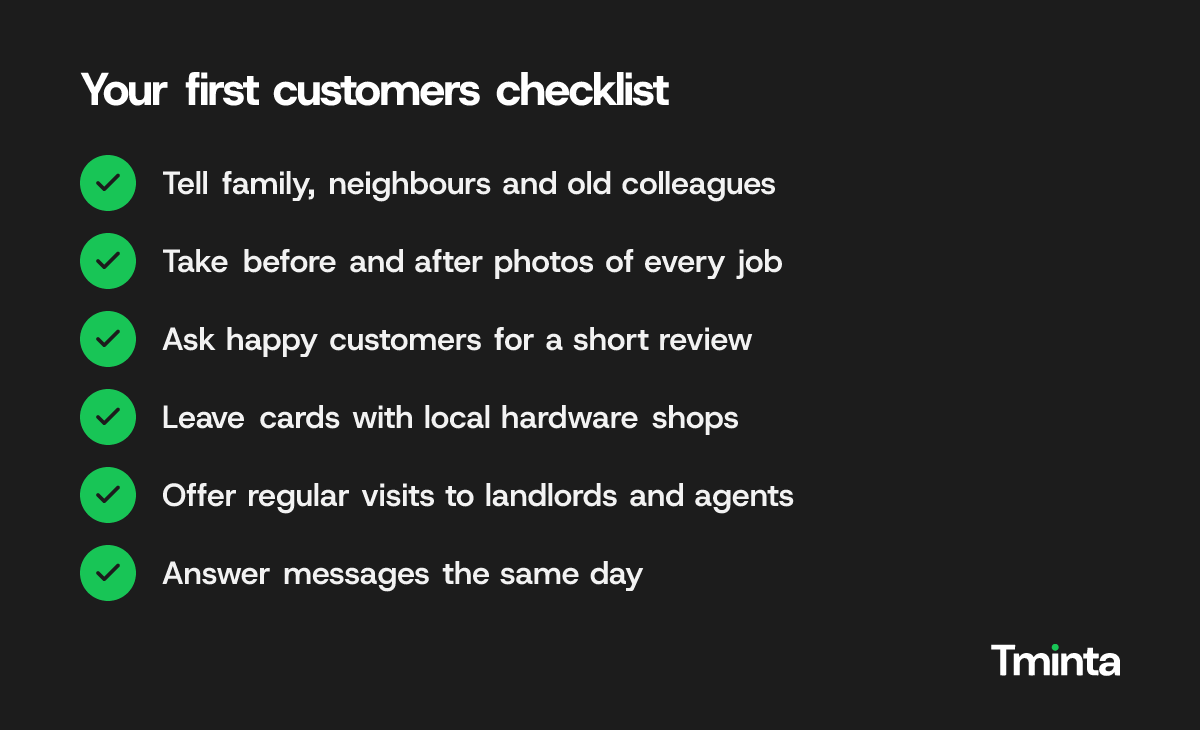
Landlords, letting agents and people who run short lets are worth chasing. They need small repairs between tenants or guests, they need them fast, and they come back. A reliable handyman who sends a photo when the job is done can end up with a set route every week.
Reviews matter more than slogans. Ask right after the job, while the customer is pleased, and make it easy: send the link in the same message as your invoice. A review that says you turned up on time and cleaned up tells the next person more than any advert.
Make it easy to find you
Most people search on their phone when something breaks, and they call or message whoever answers first. A clear profile with your towns, the jobs you do and a few photos turns those searches into calls. You can list your business on Tminta for free, so customers can WhatsApp or call you direct.
Thinking about adding electrical work? Read how to become an electrician in Malta first.
Questions people ask
What are the legal requirements to work as a handyman in Malta?
Register your self-employment with Jobsplus, get a VAT number, and pay Class Two social security contributions once you earn above the self-occupied limit. The limits on the work matter too: electrical installation work needs a REWS authorisation, and opening apertures or removing walls falls under the BCA construction licence. Keep to the jobs you are allowed to do and refer the rest.
What skills should a handyman have?
Practical skills across small carpentry, sealing, basic plumbing repairs, assembly, filling and painting. Just as important: turning up when you said, explaining the price before you start, protecting floors and furniture, and cleaning up. Knowing when a job needs a licensed electrician or builder is a skill too, and customers respect it.
Is there a handyman course in Malta?
Look for short courses in the specific skills you want to add, such as tiling, plastering or electrical work, rather than a general handyman course. For electrical work the course is only the start, because you also need a REWS authorisation before you work on an installation. Practical experience with an established tradesperson is often the fastest way to learn.
How much should a handyman charge in Malta?
It depends on travel and parking, the time on site, who supplies the materials, the tools the job needs and how urgent it is. Work out your costs first: van, fuel, insurance, contributions and tools. Then decide on a call-out charge, an hourly rate or fixed prices for common jobs, and tell customers before you start.