
How to Choose an Accountant in Malta
A good accountant saves you time, fines and worry. This guide shows how to check one in Malta, what to hand over, the questions to ask, and how to tell a good fit from a risky one.
Updated 3 November 2026 · 7 min read
Start with what you actually need
"Accountant" covers a lot of different work. Before you contact anyone, write down which of these jobs you want done. It makes quotes easier to compare, and it stops you paying a large firm for a small job, or a bookkeeper for work only a warrant holder may sign.
| Job | Who usually does it | Good to know |
|---|---|---|
| Keeping your books and receipts in order | Bookkeeper or accountant | The cheapest part to hand over, and the one that makes everything else faster. |
| VAT returns | Accountant or registered tax practitioner | You can give them access to file in your name, so you never miss a deadline. |
| Your income tax return as a sole trader | Accountant or tax practitioner | You still sign it, or they sign as your representative, and you stay responsible for what it says. |
| Payroll for staff (FSS) | Accountant with payroll experience | Ask which payroll software they use and who files the monthly and yearly forms. |
| Company annual accounts | Accountant, with an auditor | Most companies file accounts with an auditor's report each year. |
| The audit itself | A holder of a practising certificate in auditing | Only these people may sign an audit in Malta. |
If you are self-employed and just starting, read the freelancer's guide to Malta tax, sales and expenses first. You will understand what your accountant is doing, and you will ask better questions.
Check the CPA warrant on the public register
This is the one check you should never skip. In Malta, practising as an accountant needs a warrant, and the register of warrant holders is public and free to search.
Under the Accountancy Profession Act (Cap. 281), no person may practise the profession of accountant unless they hold a warrant, except where regulations made under the Act say otherwise. The Accountancy Board issues the warrant.
SourceA warrant holder may use the designation Certified Public Accountant and the abbreviation CPA. Anyone else who uses those titles, or suggests in any other way that they may practise as an accountant or act as an auditor in Malta, commits an offence.
SourceThe Accountancy Board's online registers list CPA warrant holders, holders of a practising certificate in auditing, audit firms and accountancy firms, as well as withdrawals, de-registrations, sanctions and defaults. You can search them by name and see the warrant number.
Source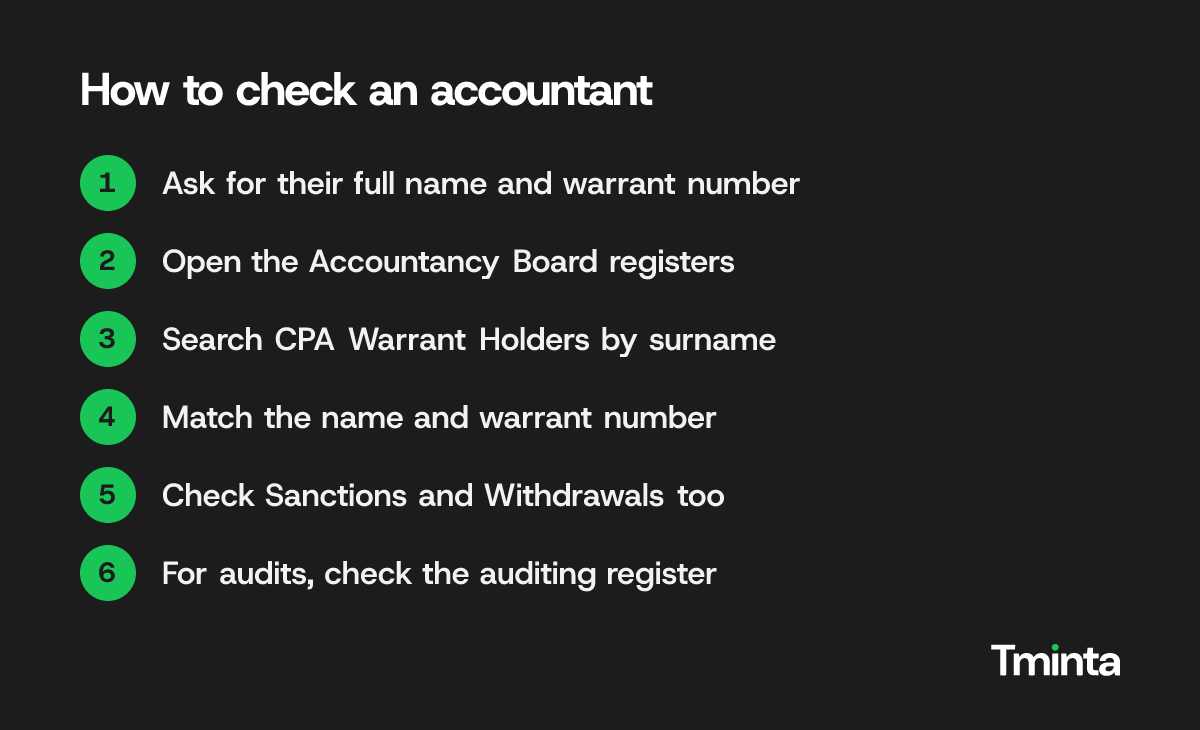
Plenty of good bookkeepers do not hold a warrant, and for keeping your books that is fine. Just do not let anyone call themselves a CPA, or sign work that needs one, unless their name is on the register.
Know what stays your responsibility
Hiring an accountant hands over the work, not the responsibility. Malta's tax system for sole traders is based on self-assessment, so it pays to know which parts stay with you.
Sole traders file a tax return and make their own assessment of their income. The return is signed by the sole trader, or by a representative who accepts and is aware of everything given to the tax authorities. If a return is not filed, the authorities can issue a tax statement based on estimated amounts.
SourceTax not paid by the tax settlement date starts to carry interest. At the time of writing (November 2026), the Malta Tax and Customs Administration states a rate of 0.33% a month until the tax is paid in full.
SourceA sole proprietor can assign the filing of their VAT return to a registered tax practitioner (form MTCA02) or to a trusted person who is not a registered practitioner (form MTCA03).
SourceSelf-employed people register for VAT under Article 10, 11 or 12 of the VAT Act, depending on what they sell and buy. Article 11 is for small undertakings that do not charge VAT and cannot claim back VAT on their costs.
SourceIn practice, this means two things. First, check every return before it is filed, even if you only skim the totals. Second, send your accountant what they need on time. Most late filings start with a box of receipts handed over the week before a deadline.
If you run a company: audit and annual filings
A limited company has more paperwork than a sole trader, and some of it has fixed deadlines with the Malta Business Registry. Your accountant should know these by heart and remind you before each one.
Every company must file an Annual Return with the Registrar of Companies within 42 days after each anniversary of its registration. A director or the company secretary signs it.
SourceCompanies must also file their annual accounts, generally with the auditors' report and the directors' report. The accounts must be approved within 10 months from the end of the financial year and filed within 42 days after that, online only. Very small private companies that meet limits set in the Companies Act may be exempt from the auditor's report.
SourceAudits and review engagements may only be carried out by an individual holding a practising certificate in the field of auditing, issued under the Accountancy Profession Act.
SourceAsk early whether the accountant does the audit too, or works with a separate auditor. Both are normal. What matters is that you know who signs, and that the audit is booked well before the filing deadline.
Questions to ask before you hire
A short call tells you a lot. Speak to two or three accountants and ask each one the same questions, so you can compare the answers fairly.
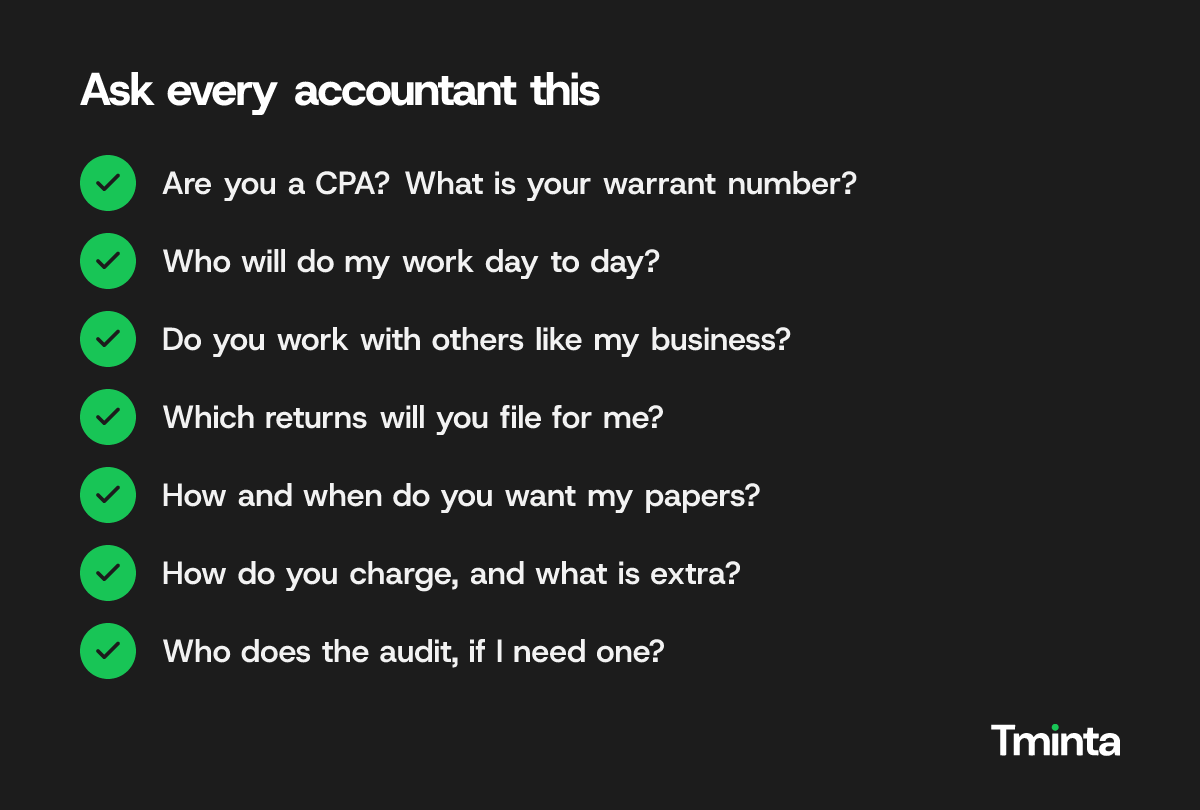
- Experience with your kind of business. A café, a freelancer and a holding company need very different things. Ask for the type of clients they work with, not their names.
- Who you will deal with. In a bigger firm, the CPA may sign while a junior does the books. That is fine, as long as you know who to call.
- How they want your papers. Photos on an app, a shared folder, a box each quarter? The method matters less than agreeing one.
- Software. Ask which accounting and payroll software they use, and whether you can see your own figures in it.
- Deadlines. A good accountant sends you a calendar of what is due and when, and reminds you before each date.
- Insurance. Ask whether they hold professional indemnity insurance. It protects you if they make a costly mistake.
How accountants set their fees
Fees in Malta vary a lot, so compare what is included rather than the headline number. Ask for a written quote that lists each job: books, VAT returns, the tax return, payroll, annual accounts and the audit.
| What | Why it changes the fee |
|---|---|
| How many transactions you have | More invoices and receipts means more bookkeeping time. |
| How tidy your papers are | Sorting a year of loose receipts costs more than reading a clean spreadsheet. |
| Sole trader or company | A company adds annual accounts, the annual return and usually an audit. |
| Staff on payroll | Each employee adds monthly payroll work and yearly forms. |
| VAT registration type | Article 10 registrations file regular VAT returns; Article 11 registrations have less to file. |
| Fixed fee or hourly | A fixed monthly fee is easier to budget; hourly can suit very small or one-off jobs. |
The surprise on most accounting bills is the extra work: a letter for a bank, a late catch-up, a meeting with the tax office. Ask how those are charged before you sign.
Red flags to watch for
- They call themselves a CPA, but you cannot find them on the Accountancy Board register.
- They will not put the fee, or what it covers, in writing.
- They ask you to sign returns without letting you see them first.
- They promise to cut your tax bill before they have seen a single figure.
- They are vague about who does the audit, or offer to "sort it" without naming an auditor.
- They hold your records and will not give them back if you move to another accountant.
If you are a bookkeeper or accountant yourself and want to set up on your own, our guide on getting started in accounts in Malta covers the warrant, the training routes and finding your first clients.
Find an accountant in Malta
Tminta lists accountants, bookkeepers and tax accountants in Malta who work with self-employed people, small companies and individuals. Contact them directly, ask the questions above, and check the warrant on the register before you hand anything over.
Questions people ask
How do I check if an accountant in Malta is qualified?
Ask for their full name and warrant number, then search the Accountancy Board's online register of CPA warrant holders. It is free and public. If you need an audit, also check the register of practising certificate holders in auditing, and look at the sanctions and withdrawals lists while you are there.
Do I need an accountant if I am self-employed in Malta?
The law does not make you use one, but most self-employed people do. You file your own tax return and, if registered under Article 10, regular VAT returns. An accountant or registered tax practitioner can file these in your name, keep your books and remind you of deadlines, while you stay responsible for what is declared.
How much does an accountant cost in Malta?
It depends on how much work you give them. The number of invoices and receipts, how tidy your papers are, whether you are a sole trader or a company, staff on payroll and whether you need an audit all change the fee. Ask two or three accountants for a written quote that lists each job, then compare what is included.
Does every company in Malta need an audit?
Companies generally file their annual accounts with an auditors' report. The Malta Business Registry says very small private companies that meet limits in the Companies Act may be exempt from the auditor's report. Only a holder of a practising certificate in auditing may carry out an audit, so ask your accountant who will sign it.